Monday, October 17, 2011

Day 2 - London

Houses of Parliament
 After a restful and much needed night sleep, we toured the City of Westminster on the second day of our European vacation. Luckily, this is in the same neighborhood as our hotel and most of the sites were within a few blocks.

The first stop was the very cool-looking, gothic-style Houses of Parliament. It is a shame that the pictures do not do it justice. The building was enormous. The Houses of Parliament is a single building consisting of 1,100 rooms and containing the two houses of Parliament, the House of Commons and the House of Lords.
Houses of Parliament

As with most of the older structures of London, the Parliament building suffered damage from several fires and the Blitz in 1940. Its last reconstruction was completed in 1941, and the structure was listed as a UNESCO World Heritage site in 1987.


Big Ben


Apparently, Big Ben is leaning!  We heard the London icon was in danger of one day tumbling into the Thames River on the news the night we gazed upon the Parliament Building.

Big Ben is the nickname of the great bell atop the tower at the north end of Parliament Square. The name Big Ben is generally extended as the entire tower structure.

The bells inside the 320-foot-tall tower were so loud I debated calling my mom so she could hear their tolling power. Alas, I doubt she would've appreciated a call at 2:30 a.m. Houston time.

We did have a fellow tourist offer to take the picture of both Snoops and I in front of the Houses of Parliament and Big Ben.


Westminster Abbey - North Facade


After visiting the Houses of Parliament, we ambled over to historic Westminster Abbey, which most recently made headlines worldwide for serving as the site of Prince William and Catherine Middleton's royal wedding. Talk about VIP!

The church isn't just an up-and-comer on the celeb scene. It has a long history of being the stomping ground for celebrations and mournings of national and global proportions.


 Westminster Abbey has been the coronation site for England's kings and queens since 1066, and historians consider it as one of the greatest churches in the English-speaking world. The abbey contains 3,000 tombs, including the remains of 29 kings and queens. We visited many of the tombs inside the church, including the tombs of Queen Elizabeth I and her sister Mary Queen of Scots. Also, the tombs of the two princes murdered in the Tower of London were buried in the same chapel as Queen Elizabeth I.


Snoops had a great time exploring the tombs and memorials to some of the greatest writers in Poet's Corner, a section of the abbey designated for literary folk. Some of the writers he had studied in college years were buried at the abbey. We saw the memorials and tombs for William Shakespeare, Geoffrey Chaucer, Charles Dickens, and Rudyard Kipling just to name a few.


Text on the outer wall of Westminster Abbey


"May God grant to the living, 
Grace to the departed, 
Rest to the church & the world,
Peace and concord
and to us sinners
Eternal Life" was found carved into the exterior of the abbey.


 I remember walking into the abbey for the first time and feeling so small. The floors were the typical checkered black and white and just on the inside began the memorials and tombs. The nave is flanked by side aisles which contain rows of smaller, themed chapels. The chapels sometimes were very crowded with the tombs and it was hard to believe that sometimes I was stepping on grave sites.


Inside, near the western entrance contained the tomb of the unknown warrior. The warrior was brought from France in November 1920 to be buried "with the kings because he had done good to God and toward his house." The Queen herself laid a wreath of red flowers around the grave.

Archway over the northern entrance to Westminster Abbey


After we completed our audio guided tour of Westminster Abbey, we crossed the busy streets over to visit Whitehall. Whitehall is the main artery of Britain. It's a road running north-south from Parliament Square towards Charing Cross to the southern end of Trafalgar Square. It is recognized as the center of British Government and is the access point for 13 of its top federal authorities. British authorities found on Whitehall include the Ministry of Defence, the formal Scotland Yard building, HM Revenue and Customs, Department of Health and the Cabinet Offices.


 Right in the middle of Whitehall is the semi-obelisk honoring those lost in World War I and II. The actual war monument is the tomb atop the obelisk, which is without markings except for "The Glorious Dead."

Going through history in school, we had learned about the world wars, but since the United States has (thankfully) never had to fight a war of the same magnitude on home soil the world wars always seemed so far away. We found London and Paris had not yet completely recovered from the two world wars.

The tomb for "The Glorious Dead" is empty and remains so as a symbol for those who went to battle only to never return.

While walking down Whitehall, we came across a heavily guarded gate. This is the residence of the Prime Minister. Of course, he wasn't outside greeting the tourists, but the officers seemed to work with the tourists by allowing photographs. To be honest, I am not sure which window was his. Snoops pointed and I snapped.


Royal Blue - Standing Guard

We continued down where we found the Royal Blues standard guard at the back entrance to the St. James Park of Buckingham Palace. The guards have stood here for over 200 years and they are considered the Queen's royal bodyguards.

I felt so bad for the poor guards. The had to sit like this while onlookers made silly faces and posed for the cameras. The horses didn't seem amused either. Even though I felt bad for all of the guys having to have their picture taken, I still took one of them and of the horses.
Horse of a Royal Blue
 As mentioned before, we walked south along Whitehall toward Trafalgar Square. Trafalgar Square was teeming with locals and tourists, like a giant playground for everyone. At the center of the square is a 170 foot-tall Corinthian column adorned with a statue of Admiral Horatio Nelson.

At the corners of the column's base were four huggable lions. From a distance, we could see kids and adults posing for pictures atop the lions, so I was excited to get my own picture with one of the big guys. But as we inched closer to the kings of the jungle, I discovered how big they really were. I had to scale a six-foot-tall marble wall just to reach the base the lions were perched upon, and that's not easy for someone of my size. Snoops was able to help me climb the wall, but the top of the lions' rear ends were six feet above that. Kids were able to reach the lions back with the help of their parents. Despite Snoops' encouragement, I didn't get my picture.
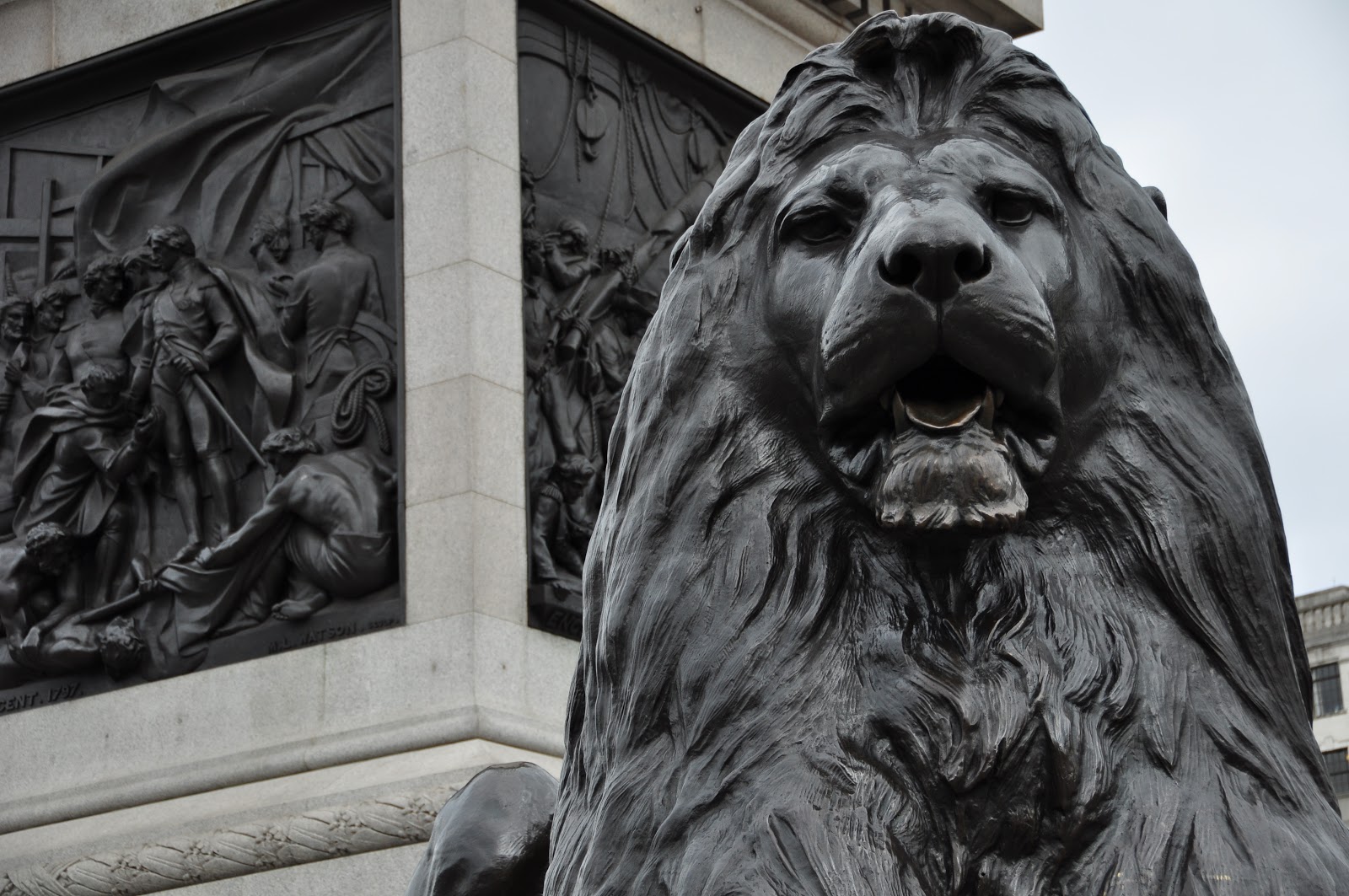
Lion at Trafalgar Square


 Across the square from the column was the British National Gallery. So many people had packed its entryway that Snoops and I became concerned about a chaotic environment similar to the British Museum.

National Gallery


 While standing in Trafalgar Square, Snoopy had a sparkle in his eye about the thought of visiting Emirates Stadium, the home of his favorite football team - Arsenal. When I refer to football here, it is soccer, but since we were in England and they refer to it as football, it is football here. There was no way that I could deny Snoops his chance to tour the stadium, so we hopped into the nearest London Underground station bound for Islington.

Box Office at Emirates Stadium

Emirates Stadium
 We left the Islington stop and strolled through the very diverse neighborhood bound for Emirates Stadium. There weren't as many tourists on this route so it was different seeing the true England and Londoners about their daily lives. As we turned our last corner, Emirates Stadium showed itself between the buildings in the distance in its red glory. I do not get to see Snoopy so excited often, so I was thrilled to be with him while he explored something he loved.
Emirates Stadium


We took a guided tour with about 15 other Gunners fans. We began in the visitors owner's box, where we had an amazing view of the stadium. Emirates is the new stadium that in 2006 replaced its much-loved predecessor, Highbury. In the box, the leaders of the visiting team are greeted unlimited alcohol and flowers bearing the colors of their squad. If Chelsea were  to visit, then the flowers would be blue. If Manchester United were to visit, the flowers would be red and white.
Tunnel on to the pitch


Next, we moved down into the players locker room, where the players prepare for the upcoming match. The players in the home side get luxuries, including rubber floors to prevent slipping, hot tubs and showers. The room itself is designed to fit to Feng Shui standards in an attempt to bring the best of luck to the players.

After the players are ready, they make their way through the tunnel onto the pitch. It reminded me of walking through the tunnel at Rice Stadium before a band competition.
Pitch under false sunlight


The pitch is what Americans call the field. They take extremely good care of the pitch, not only to keep the ball rolling properly but also to protect the players who cannot have the extra stability of taped ankles. The pitch has a mixture of a fake turf sewn into the sod to prevent divots and destruction. They can play several games a week without any damage to the pitch.


Since England does not get as much sun as Houston, they have false light machines that roll over the field to provide the sunlight required for growth.


At the top of Emirates is a replica of the famed Highbury clock. Snoops was fascinated by this because he thought at first it was the same clock that was at Highbury. When he asked the tour guide, she claimed that the original clock was so small it appeared like a wrist watch so they made a replica for Emirates.

Seats for Arsenal Players
 We were sad to leave Emirates, but it was a worthwhile trip to Islington. I am very happy that Snoopy got to see it first hand.

We made our way back into central London and walked London's east end, where we found some dinner. We ended up stopping in an old pub and restaurant where we tried true England beer. I learned here that I actually do like beer, I just like the beer that probably cannot be found in the United States.
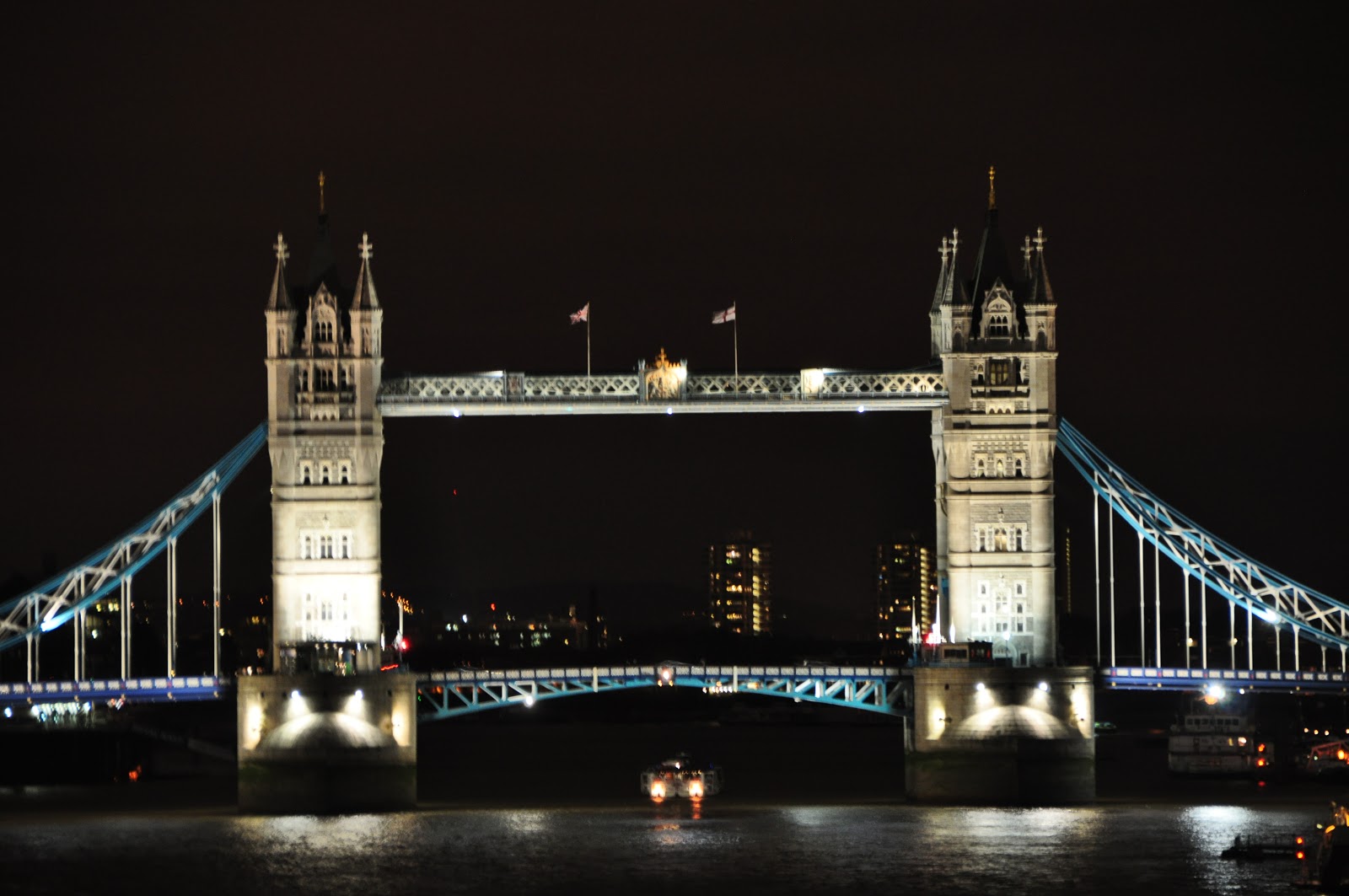
Tower Bridge

After dinner, we continued our Thames River walk where I snapped some lovely pictures of bridges that stretch over the mighty river.

Snoopy said that I was obsessed with the Tower Bridge. How could I not be? It looks so neat and takes wonderful pictures. Tower Bridge looked old but it was completed in 1894 so it is not as old as it looks.
London Bridge


London Bridge is consistently confused with Tower Bridge. London Bridge has a history beginning with the first rendition in 55 AD. It was the only bridge to cross the Thames until 1729. The London Bridge is also where the heads of the recently executed were placed as a warning to others not to commit treason. London Bridge has been re-built many times with the most recent being completed in 1973.


One of the last pictures that I snapped from the other side of the Thames River was of the great St. Paul's Cathedral at night time. I later found it to be one of my favorite churches in London.
St. Paul's Cathedral


Sunday, October 16, 2011

Day 1 - London

Ever climb almost 600 steps up the shoulder-tight, winding staircase of a 400-year-old church only to spend the few crucial moments atop its dome debating the merits of rooftop sod placement?

After more than one year of saving, Snoopy and I finally stepped onto an airplane destined for an eight-day stay in London and Paris, two of the world's greatest cities.
Colorful flowers draped over window balconies

Like the hours-long excursion to the dome of London's famed Saint Paul's Cathedral, the European vacation did not go off as planned. We got lost in the maze of London's busy streets while attempting to reach our hotel. I tried to make the best of the situation by snapping pictures. I was struck by the plethora of greenery in the city. I thought the pictures would also help Bobbies piece together our final moments in case Snoops was unable to find the hotel, leading to certain death of thirst and starvation.

Buckingham Palace, the 830,000-square-foot home to Britain's sovereigns, was majestic. The palace has served as the administrative center of the British monarch since 1837, and it is the focal point of Britons during times of joy and crisis. Buckingham Palace was originally built in 1705 for the Duke of Buckingham. King George III purchased it in 1761 for Queen Charlotte and it was temporarily named "The Queen's House". Buckingham Palace became an official palace of the British monarch in 1837 by Queen Victoria.

Despite the somewhat overcast sky, the stone courtyard in front of the palace was bustling with tourist taking pictures of the golden and iron gates that protect her majesty. Unfortunately, we were unable to visit the inside of the palace since it is the winter home of her majesty and family during the winter. This did not stop us from taking pictures of the palace from the outside and exploring the courtyard in front.

Buckingham Palace


Lion outside Buckingham Palace gates
 As with most places with an association with the royal family, statues of lions adorned the entrances to the palace. The lions here made Snoopy laugh since they had their giant paw on the shield with Queen Elizabeth's crest and were wearing crowns. Lions are a symbol of royalty, power and bravery. We learned later that most of the monarchs had a lion somewhere in their crest. Queen Elizabeth II has a lion and a unicorn.
Buckingham Palace

Gates at Buckingham Palace


The gates to the palace were ornately decorated with gold at the tips of the iron and in the crest of the queen. You can see in the picture the lions used in the queen's family crest. It is hard to tell from the picture, but these gates were probably about 15 feet tall.


Buckingham Palace
 We were happy to come across the palace since this only meant that we did not have to come back to it later. Our list of activities was so great and finding the hotel was taking so long that we were happy to have knocked one activity off of a later list so we could do everything we wanted later. It was sad leaving the palace behind because I loved looking at it. Understanding the history that we were standing on really made me feel humble. It is hard to imagine that the palace had seen so much sorrow, loss, rejoicing and celebration.


Westminster Cathedral
 We didn't realize it right away,  but when we found the Westminster Cathedral we were only a few blocks away from our hotel. Westminster Cathedral did not allow us to take photos inside but we did step inside to check it out. Surprisingly, it is the mother church of the Catholic community in England and Wales. It is the largest Catholic church in England and Wales and it is not to be confused with Westminster Abbey which is the head of the Church of England. This cathedral was opened in 1903 and is the home of the Archbishop of Westminster. As a custom, each Archbishop of Westminster has been created a cardinal.

We finally made our way around and found the hotel to drop off our luggage until check-in time. We then made a beeline for the British Museum. The British Museum contains more than 7 million objects of human history and culture and is considered the largest and most-comprehensive natural science museum in the world. It houses artifacts from all seven continents.
Rosetta Stone
One of the first artifacts that we came across was the famed Rosetta Stone encased in glass and surrounded by many curious onlookers. The stone was not quite as big as I had expected, but if you look at the detailed work, it is hard to imagine that someone chiseled this into the stone of granite.

The Rosetta Stone is important since it was used to decipher ancient Egyptian Hieroglyphics. The text is the same decree given by King Ptolemy in 196 BC in three different languages: Ancient Egyptian Hieroglyphics, Demotic and Ancient Greek. It took 20 years for Jean-Francois Champollion to finally announce in 1822 that the text had been deciphered.
Rosetta Stone

The stone has survived a long and tumultuous history since its re-discovery in 1799. The British defeated the French in Egypt in 1801 and the stone was transported to London where it has been on display since 1802. It is the most visited artifact in the British Museum. In 2003, Egypt requested its return. However, in 2009 Egypt offered to drop the request if the British Museum offered to loan it to Egypt in 2013 for it's opening of the Grand Egyptian Museum in Giza.

Surprisingly, the Rosetta Stone is not unique and many nations are declaring its use in many other museums across the world to be accessible by all people.


side of a sarcophagus 


The British Museum was so big that we could not have gone through the whole thing in the time that we had allotted for it. It was also chaos since it has no admission fees. It was filled with some of the most magnificent items from ancient Greece and ancient Egypt including the beard from the great Sphinx. There are more pictures that Snoopy took that I did not include here.


After we picked up some lunch, we went to explore the Tower of London. The Tower of London  was founded in 1066 and has plead a very prominent role in England's history. It has served as an armory, treasury, menagerie, home of the Royal Mint, public records office and housed the Crown Jewels of the United Kingdom.

Tower of London
I have to admit that I was not well versed in this part of history and did not realize that the Tower of London is a very small and functioning town. The Tower of London was originally built by William the Conquerer and started only as the single White Tower and it was a resented symbol of oppression inflicted by the new elite. In 1100 it was used as a prison although its initial purpose was not to be a prison. Many expansions were made in the 12th and 13th centuries but the general layout from the 13th century is what is there today.


The White Tower
 The Tower of London has a bloody history. Many people have been executed to the delight of crowds of people and families who enjoyed a day from work to watch the festivities. We took a guided tour from a Yeoman Warder of the tower where we learned more about some of the history that is not always easily found. It is hard to believe that people such as Queen Anne Boleyn was executed by sword at this place. It was said that Queen Anne had a terrible fear of the axe so an expert swordsman was brought in from France to perform her beheading. The sword was so efficient that when Queen Anne knelt down to say her prayers and the executioner performed his duties, he grabbed her head to hold for the crowd and her eyes were still looking around and her mouth was still moving as if still in prayer. Queen Anne Boleyn is also said to haunt the chapel in which she is buried. Some have witnessed the ghost of the queen wandering around the White Tower with her head under her arm.


Tower of London with Tower Bridge in the background

The Yeoman Warders also told us of the execution of James Scott, 1st Duke of Monmouth, which was particularly terrible and it gave me the chills. James Scott was the illegitimate son of King Charles II and his mistress Lucy Walter. After the execution of his Father, he attempted to have his uncle executed so he could ascend to the throne. However, his plot was foiled and he was sent to Tower Hill to await execution. 


When it came James Scott's time to march up to Tower Green in front of the crowds of family awaiting their entertainment, James Scott handed his executioner a bag of gold. Each prisoner was required to pay for their execution, probably in hopes that the executioner do a clean job. This did not work for James Scott. His executioner was drunk. The Yeoman Warders claim that it took 5 blows of the axe to finally land on the neck of James Scott and even then, it wasn't severed. The executioner finally removed his butchers carving knife and sawed the remainder of his head from his body.


Outer wall of Tower of London
  As custom, his head was lifted and shown to the crowd, put atop a spike and marched to the London Bridge as a warning to the others. However, within 24 hours, his head was returned to its body and was sewn back on and they were buried together.

Why would they sew his head back on? Since he might have been a son of the king, they realized that he didn't have a portrait of him. So they had a painter come in do paint a portrait of him. A private collector currently owns this painting and it is said that it is not very "life-like".
Bloody Tower

The Bloody Tower (shown to the right) has a very sad meaning to its name. It was the site of the murder of two very young Princes: Prince Edward V of England (possible age 11) and his brother Prince Richard, 1st Duke of York (possible age 9). The young princes were imprisoned at the time of the death of their father, Prince Edward IV of England, at the time of his death. Their uncle Richard, Duke of Gloucester, imprisoned them to keep the elder Prince from ascending to the throne. They mysteriously disappeared in the middle of the night. There is no hard evidence against the Duke of Gloucester in their disappearance and there are many likely suspects.

In 1674, the bodies were found buried in the Tower grounds and King Charles II ordered them to be buried at Westminster Abbey, where they hold are in the same chapel as Queen Elizabeth I in what is referred to as "Innocent's Corner".

Soldiers marching through the Tower of London
 The Tower of London is still working today and you will see soldiers marching through (shown right) through their various tasks of the day. We saw similar soldiers during the Ceremony of the Keys event later in the evening. They are all highly trained military personnel hand picked by the Queen. The Yeoman Warders have to go through a rigorous selection process including, at minimum, 22 years military experience, senior non-commissioned officers, and winner of a specific award, Long Service and Good Conduct medal. Yeoman Warders are not permitted to leave the grounds and are appointed for life.
The White Tower
 The White Tower was the original structure inside the Tower of London and served primarily as a place of residence. It was also a very strong military point sitting at the top of the hill overlooking the Thames River. It was a place of residence until the 1320s when it was used a place to store documents. During the Tudor reign, it served as an armory. We did visit the Royal Armoury where we saw the suits of armor for various kings. King Henry VIII was huge! 
The White Tower

 This courtyard was amazing because of the amount of Ravens that live there. King Charles II ordered that six Ravens be kept on the premises at all times to prevent disaster. One of the Yeoman Warders is designated as the Ravenmaster who takes care of the Ravens on site. It is interesting that the Ravens are under such good care that they typically live double the lifespan of a Raven in the wild. When a Raven passes, a full autopsy is performed to ensure proper care has been taken and then the Raven is buried in the courtyard.


We ended our first day by witnessing the tower's famed "Ceremony of the Keys." This ceremony has been happening at the Tower of London each night since the 14th Century. The only known time that it did not happen was during the London bombing during World War II. The tradition roots are unknown, but it started when one of the kings was able to enter the Tower of London gates without being questioned or without trouble.

The ceremony involves the Chief Yeoman Warder in Tudor Watchcoat meeting the military escorts made from members of the Tower of London Guard. He is then forced to halt by an armed sentry asking about his presence and purpose. They march through and then the Chief Yeoman Warder locks the gate and actually locks everyone inside the tower! Of course, there was a small door we could escape from with the assistance of the Chief Yeoman Warder, but it was pretty neat to be locked in such a place of history.

While the ceremony itself was short and some might consider it silly and theater-like, it was amazing to be a part of a ceremony that has been continuing for hundreds of years.
The White Tower

Sunday, October 2, 2011

why is this water so dirty?


View over Horseshoe Lake
This is probably what the alligators at Brazos Bend State Park complain about.

Gunner and I visited the state park this afternoon since the weather was nice. Each time I visited the park, I saw something new and this time was no exception. We were met by many other park visitors who were hiking with their pups and cycling through the trails.

We started our hike near Horseshoe Lake and meandered over to Big Creek Loop Trail. This was the first time I had ventured on this trail and I was excited about what we would see.

View over Big Creek
One of the new scenic views we saw was of Big Creek. I loved seeing how water carved its way through the earth. Time and time again, water sculpts the earth into the magnificent sights we see today. While this was on a smaller scale, it is still a sight to see.

It was refreshing to hear the water running underneath us and Gunner was trying to scale the cliffside to enjoy it, but it was too steep and too far for us.


Armadillo at Brazos Bend State Park


Big Creek Loop Trail offered a different side of
Brazos Bend State Park which included the native wildlife. As we were making our way through, we saw this little guy foraging through the leaves. He did not seem overly afraid, but he started in the other direction once he saw us. The only shots that I could get of him were of his tail.


Brazos Bend 


One of the benefits of walking through Brazos Bend is the large, old oak trees. These oak trees were probably hundreds of years old. I was imagining what the American Indians would see. Would they have seen the same trees that I was seeing?

I wondered what would happen if the trees could talk. These trees might have seen some of the first people to journey into Texas. They might have seen the Texas Revolution and the Civil War. What kind of history could they teach us?


No trip to Brazos Bend State Park is complete without a walk around Elm Lake to see all of the alligators. Brazos Bend offers protection to alligators from people who consider them nuisance animals and kill them.


The alligators were not as active as I have seen in the past, but they were still out and about. It is true that alligators are dangerous, but it is also true that if you keep your distance you are safe. As my dad taught me when I was younger, they are more scared of me than I am of them.


It was eerie how quietly the gators can move through the water. We found this one while we were stepping on to one of the covered piers over the lake. Gunner enjoyed walking on the piers because each one conveniently had a piece of food left behind from a picnic lunch earlier in the day.


3 alligator musketeers


This guy was probably the biggest one that we saw on our trip. He didn't budge the entire time that we walked by.


As we were leaving the park, I saw this doe on the side of the street. I stopped to grab the camera only to see that she had spotted me and was bounding across the street into the tall grass. I was able to snap this shot as she hid in the grass. I was very excited that I was able to capture it because we had seen many deer but were unable to get pictures of the deer until we left.